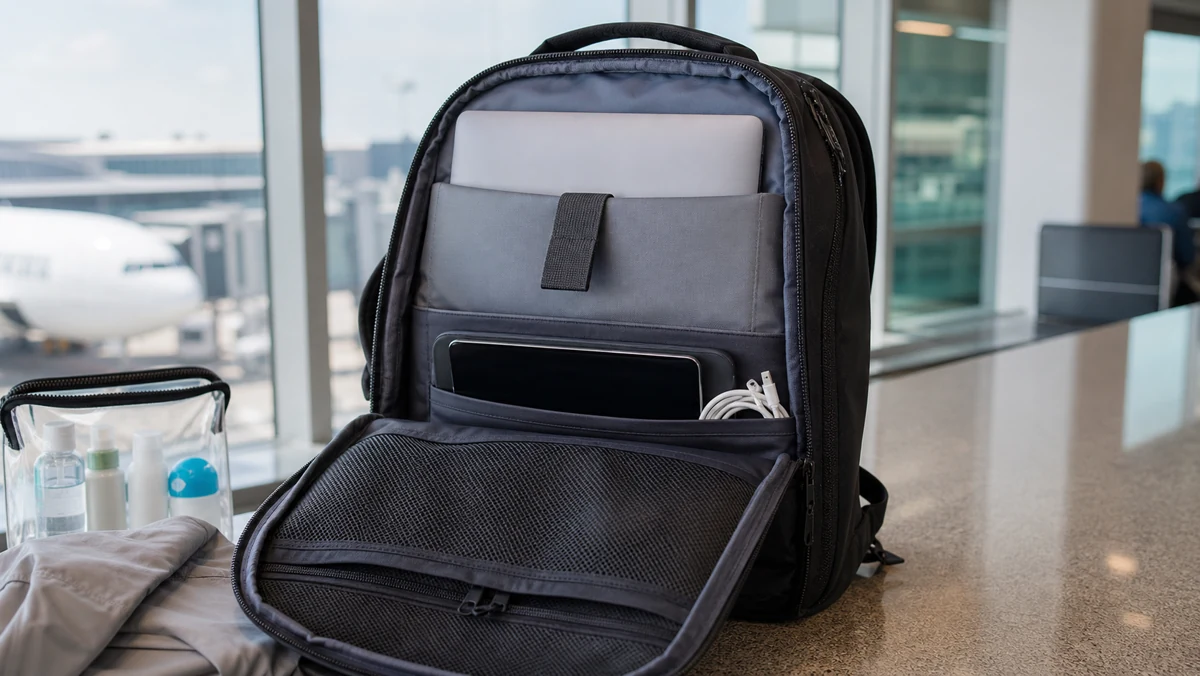
Reader-supported. We may earn a commission on purchases through our links. Disclosure ›
Yes, you can bring electronics on a plane. Almost every gadget a traveler owns is allowed in both carry-on and checked bags, and the handful of exceptions all come down to one thing: the battery. Spare lithium batteries and power banks have to ride in the cabin with you, never in a checked bag, and the size of a battery is measured in watt-hours, not milliamp-hours.
This page covers 21 kinds of electronics people ask about, from power banks and action cameras to tripods, radios, fans and humidifiers. Each section gives the carry-on answer, the checked-bag answer, the thing that actually trips people up at the checkpoint, and the official TSA or FAA source. Laptops, headphones, gaming consoles, cables and hard drives each have their own full guide, linked where they come up.
On this page
- The battery rule that decides everything
- Quick answers: all 21 items
- What you have to take out at security
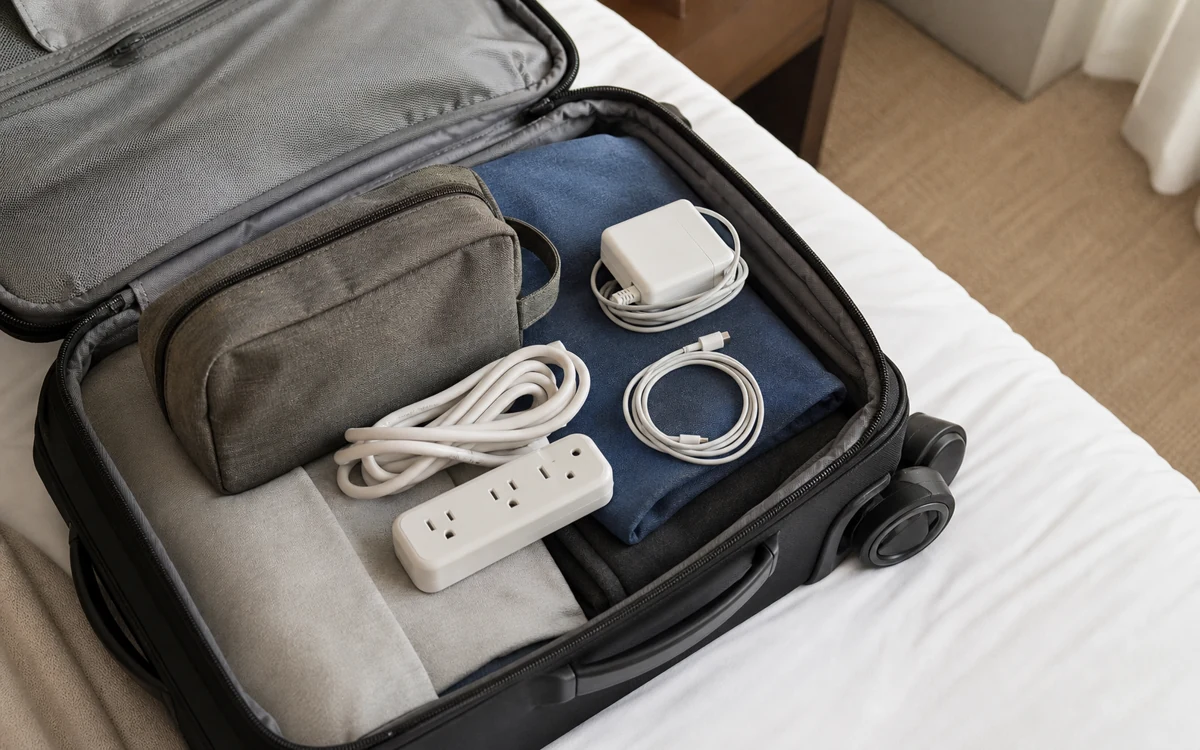
- Chargers and cables
- Power banks and portable chargers
- Action cameras (GoPro)
- Gimbals and stabilizers
- Tripods and monopods
- Selfie sticks
- Binoculars
- Telescopes
- Night vision goggles
- Kindles and e-readers
- Nintendo Switch and handheld consoles
- External monitors
- Desktop computers
- Printers and ink cartridges
- GPS devices and trackers
- Radios and stereo equipment
- Clocks and watches
- Portable fans
- Flashlights and headlamps
- Humidifiers and dehumidifiers
- Frequently asked questions
The battery rule that decides everything
Every restriction in this guide traces back to the FAA’s lithium battery rules, so it is worth reading them once. The FAA splits batteries into two groups: batteries installed in a device, and spare batteries that are not inside anything. The rules are different for each.
- Installed batteries (the battery inside your phone, camera, e-reader, watch or speaker) can travel in carry-on or checked bags. The FAA asks that devices in checked bags be powered off fully and protected from switching on by accident.
- Spare lithium batteries, which the FAA defines to include power banks and phone charging cases, go in carry-on bags only. They are prohibited in checked luggage.
- Size: a lithium-ion battery is allowed up to 100 watt-hours (Wh) with no questions asked. Batteries from 101 to 160 Wh need airline approval and are limited to two spares per person. Anything over 160 Wh is not allowed on a passenger flight.
- Terminals: spare batteries must be protected from short circuit. Keep them in the retail packaging, tape the terminals, or use a battery case.
- Gate-checked bags: if your carry-on gets checked at the gate, the FAA requires you to take every spare battery and power bank out and keep it with you in the cabin.
The FAA also notes that many airlines set stricter quantity and Wh limits than the federal rule, including caps on how many power banks a passenger can carry. If you are flying with more than a couple of batteries, check your airline’s own page before you pack. Source: the FAA’s PackSafe lithium batteries entry.
How to read a battery label
Airlines count watt-hours. If your power bank or camera battery only prints milliamp-hours (mAh), convert it: Wh = mAh x volts / 1,000. Most lithium-ion cells are rated at 3.7 volts, so a 20,000 mAh power bank is about 74 Wh and a 27,000 mAh one is right at the 100 Wh line. Anything labeled above 27,000 mAh at 3.7 V needs airline approval.
Quick answers: all 21 items
| Item | Carry-on | Checked bag | The catch |
|---|---|---|---|
| Chargers and cables | Yes | Yes | None. Coil them so the X-ray image stays readable. |
| Power banks | Yes | No | 100 Wh limit, 160 Wh with airline approval. Carry-on only. |
| Action cameras | Yes | Yes | Spare camera batteries go in carry-on only. |
| Gimbals | Yes | Yes | Battery-powered ones follow the lithium rules. |
| Tripods and monopods | Yes | Yes | Must fit your bag’s size limit. Officer’s call on heavy metal ones. |
| Selfie sticks | Yes | Yes | None at the checkpoint. |
| Binoculars | Yes | Yes | None. |
| Telescopes | Yes | Yes | Not listed by TSA. Pack optics in carry-on. |
| Night vision goggles | Yes | Yes | Battery rules apply. |
| Kindles and e-readers | Yes | Yes | Comes out of the bag at standard checkpoints. |
| Nintendo Switch | Yes | Yes | Airplane mode in flight. Carry-on is safer. |
| External monitors | Yes | Yes | Airline size and weight limits, not TSA. |
| Desktop computers | Yes | Yes | Comes out of the bag for X-ray. |
| Printers | Yes | Yes | Comes out of the bag for X-ray. |
| Ink cartridges | Yes | Yes | Treated as liquids in carry-on: 3.4 oz each, in the quart bag. |
| GPS devices and trackers | Yes | Yes | Rechargeable units follow the lithium rules. |
| Radios | Yes | Yes | Must fit the bin or under the seat. No transmitting in flight. |
| Clocks and watches | Yes | Yes | None for ordinary ones. |
| Portable fans | Yes | Yes | Must fit the bin or under the seat. |
| Flashlights and headlamps | Yes | Yes | Spare lithium batteries go in carry-on only. |
| Humidifiers and dehumidifiers | Yes | Yes | Not listed by TSA. Empty and dry it first. |
Every TSA item page carries the same closing line: the final decision rests with the TSA officer at the checkpoint. The answers above are the published rules, and they hold for almost everyone, but an officer who sees something odd on the X-ray can always ask for a closer look.
What you have to take out at security
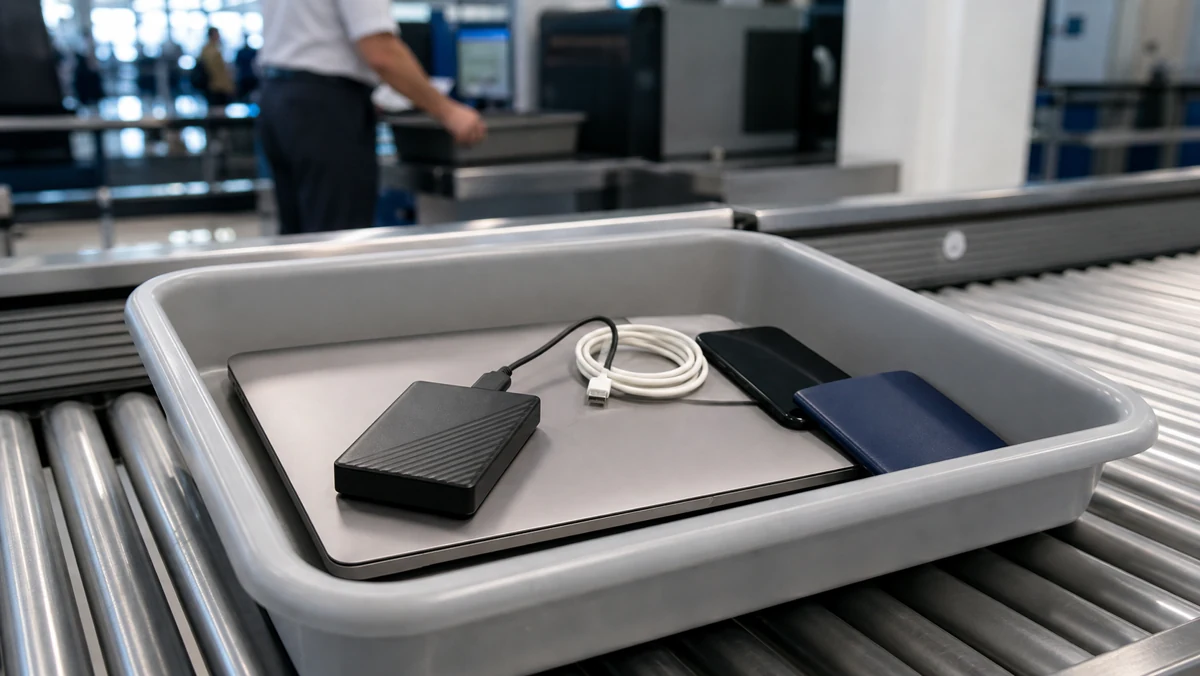
At a standard US checkpoint, TSA asks you to remove laptops and other electronics larger than a cell phone from your bag and place them in a separate bin. That includes tablets, e-readers, cameras, handheld consoles and portable monitors. TSA PreCheck travelers can leave laptops, liquids, shoes, belts and light jackets in place. Source: TSA’s laptops entry.
Two habits make this painless. Pack the devices you will need to remove near the top of the bag, and coil cables and chargers in one pouch. A bag full of loose wires produces a cluttered X-ray image, and cluttered images get pulled for a hand search. Our airport security rules guide walks through the whole bin routine.
Chargers and cables
Carry-on: yes. Checked: yes. Wall chargers, laptop bricks, car chargers, wireless charging pads and every kind of cable are allowed in both bags with no limit. None of them contain a lithium battery, so none of the battery rules apply. A wireless charging pad produces a magnetic field far too small to matter on an aircraft, and airlines have no rule against carrying one.
The one exception is a wireless earbud case. The case itself holds a small lithium battery, which makes it a device, not a cable. It is still allowed in either bag, but keep it in your carry-on so it is treated like any other battery device. You can use chargers in flight on any seat with a power outlet; our airplane power outlets guide covers which airlines offer them.
Extension cords and power strips have their own small set of rules, covered in Can You Bring an Extension Cord or Power Strip on a Plane?
Power banks and portable chargers
Carry-on: yes. Checked: no. This is the one item on the page with a hard no. TSA’s rule is a single sentence: portable chargers and power banks containing a lithium-ion battery must be packed in carry-on bags, and spare lithium batteries are prohibited in checked luggage. If a power bank is found in a checked bag it will be removed, and you will not get it back.
Within the cabin the FAA size limits apply: up to 100 Wh with no approval needed, 101 to 160 Wh with airline approval and a maximum of two, and nothing above 160 Wh. Most power banks sold for phones are between 10 and 75 Wh. The big “laptop” power banks are the ones to check, since 27,000 mAh at 3.7 V is already 100 Wh. Source: TSA’s power banks entry and the FAA lithium batteries rule.

Three ways people still lose a power bank
- Gate-checking the carry-on. When an overhead bin fills up and your bag is tagged at the gate, the power bank has to come out and go with you to your seat. Airlines enforce this.
- No rating on the label. A power bank with no Wh or mAh marking can be refused, because nobody can prove it is under the limit. Keep the label legible or carry the box.
- Airline caps. The FAA explicitly allows airlines to limit how many power banks you carry regardless of size. Some international carriers also ban using them in flight. Check the airline page when you fly abroad.
Solar power banks follow exactly the same rules as ordinary ones, because the solar panel is just a slow charger bolted to a lithium battery.
Action cameras (GoPro and similar)
Carry-on: yes. Checked: yes. A GoPro, DJI Osmo or any other action camera is allowed in either bag with the battery installed. The rule that matters is for the spare batteries most action camera owners carry: those are spare lithium batteries, so they go in the carry-on only, with the terminals covered or each battery in its own case. A charging case that holds two or three batteries counts as spares too.
Keep the camera itself in your carry-on anyway. A checked bag gets thrown, stacked and sometimes lost, and a camera is one of the first things taken from an opened bag. Full-size cameras and lenses are covered separately in Can You Bring a Camera on a Plane? Source: the FAA spare battery rule, which lists cameras by name.
Gimbals and camera stabilizers
Carry-on: yes. Checked: yes. TSA has no entry for gimbals, which puts them under the general rule that anything not prohibited is allowed. A mechanical stabilizer, cage, top handle or shoulder rig is simply metal and plastic and raises no questions. A motorized gimbal has a lithium battery inside, so the installed-battery rules apply: fine in either bag, better in the cabin, and any spare gimbal batteries must travel in the carry-on.
A folded gimbal is larger than a phone, so expect to take it out of the bag at a standard checkpoint. Motorized camera sliders follow the same logic: allowed, battery rules apply, and they have to fit the airline’s carry-on dimensions if you want them in the cabin.
Tripods and monopods
Carry-on: yes. Checked: yes. TSA lists tripods as allowed in both bags with no special instructions. In practice two things decide whether yours rides in the cabin. First, it has to fit your bag: a standard carry-on runs about 22 x 14 x 9 inches and a personal item about 18 x 14 x 8, so a tripod that folds under 20 inches fits diagonally and one over 30 inches does not. Second, a heavy metal tripod can draw a second look from an officer, because a long solid metal object is exactly what the X-ray flags. Carbon fiber and small travel tripods pass without comment. Source: TSA’s tripods entry.
Monopods, mini tripods and flexible-leg tripods are treated the same way. If the tripod is too long for the cabin, check it inside a hard case or wrapped in clothing in the middle of the suitcase, and keep the ball head in your carry-on. Airline size and weight rules are collected in our luggage size guide.
Selfie sticks
Carry-on: yes. Checked: yes. TSA lists selfie sticks as allowed in both bags, whatever they are made of. A selfie stick with a built-in tripod is treated like a tripod, and one with a built-in gimbal or Bluetooth remote has a small battery that follows the installed-battery rules. None of that changes the answer; it only means a battery-powered one belongs in your carry-on. Source: TSA’s selfie stick entry.
Binoculars
Carry-on: yes. Checked: yes. Binoculars are on TSA’s allowed list for both bags with no conditions. Pack them in the carry-on inside their case, lens caps on, and if an officer asks to see them it is only because dense glass and metal look solid on the X-ray. Source: TSA’s binoculars entry.
Telescopes
Carry-on: yes. Checked: yes. TSA does not currently publish a telescope entry, so a telescope travels under the general rule: it is not a prohibited item, and the officer at the checkpoint has the final say. Small refractors and spotting scopes go through like binoculars. The practical problem is size and fragility, not security. Carry the optical tube, eyepieces and any electronics in the cabin in a padded case, and check only the tripod and mount, wrapped so nothing can shift.
A motorized mount or a computerized telescope has a battery, and a large external battery pack for the mount is a spare lithium battery with all the usual limits, including the 100 Wh line.
Night vision goggles
Carry-on: yes. Checked: yes. TSA lists night vision goggles as allowed in both bags. The same goes for night vision binoculars, monoculars and cameras. The only rules that apply are the battery rules: most units run on AA or CR123 cells, which are fine anywhere, while rechargeable models with lithium-ion packs follow the installed and spare battery limits. Night vision equipment does not interfere with aircraft systems. Source: TSA’s night vision goggles entry.
If you are traveling internationally with military-grade equipment, the issue is export control at the destination, not the airport checkpoint. That is a customs question, and a very different one.
Kindles and e-readers
Carry-on: yes. Checked: yes. A Kindle, Kobo, Boox or any other e-reader is a tablet as far as TSA is concerned, allowed in both bags and subject only to the FAA battery rules, which every e-reader clears by a wide margin. At a standard checkpoint it comes out of the bag with the other electronics larger than a phone. Source: TSA’s tablets entry.
In flight, switch on airplane mode and read as long as you like; airlines allow personal electronics in airplane mode through takeoff and landing, and the crew will tell you if they want something stowed. Keep the e-reader in your carry-on rather than checking it. It is light, it is easily broken under a pile of bags, and you will want it on the plane anyway. Charge it to full before you leave: a plug adapter is enough abroad, since the charger handles any voltage.
Nintendo Switch and handheld consoles
Carry-on: yes. Checked: yes. A Switch, Steam Deck or any handheld console is an electronic device with an installed lithium battery: allowed in both bags, best kept in the cabin, and taken out of the bag at a standard checkpoint. Use it in airplane mode once the crew allows electronics, which on most airlines is for the whole flight.
Full-size consoles, controllers, docks and the question of how to pack a PlayStation or Xbox are covered in Can You Bring a Gaming Console on a Plane?
External monitors
Carry-on: yes. Checked: yes. TSA has no rule against monitors, and a portable USB-C monitor is just another electronic device larger than a phone: it goes in the bin at the checkpoint and otherwise raises no questions. Whether it can fly in the cabin is an airline question, and the airline measures the whole packed bag or box, not the screen’s diagonal. There is no fixed screen size above which a monitor must be checked. Measure the monitor in its sleeve or box, stand and foam included, against the airline’s published carry-on dimensions, roughly 22 x 14 x 9 inches on most US carriers. Slim portable displays fit easily; a desktop monitor in its retail box usually does not and travels as checked or oversized baggage, which some airlines want confirmed in advance.
Check the label before you pack. Many portable monitors have no battery and draw power from the laptop, so they are simply fragile electronics. Others have a built-in lithium battery, which makes carry-on the right place for them and, if they must be checked, means switched fully off and protected from damage and from switching on, per the FAA. A separate power bank for the monitor is a spare battery and stays in the cabin. Never fly with a swollen or damaged battery.
If you have to check a monitor, use the original box with its molded foam or a fitted hard case, wrap the stand separately so it cannot strike the panel, and photograph the working screen and the packed box before check-in. A few towels around a bare screen are not enough. Buying a monitor abroad and bringing it home is allowed, but you declare it at customs like any other purchase. The related question of checking a laptop is answered in Is It Safe to Put a Laptop in Checked Luggage? Source: the FAA’s PackSafe entry for devices with batteries.
Desktop computers
Carry-on: yes. Checked: yes. TSA lists desktop computers as allowed in both bags, with one instruction: at the checkpoint the computer comes out of the bag and goes in its own bin, exactly like a laptop. The X-ray does not harm hard drives or SSDs. Source: TSA’s desktop computers entry.
The real decision is how to move it. A tower in the cabin is safe but has to fit the carry-on limits, which rules out most full-size cases. In a checked bag it needs real protection: the drive removed and carried with you, cards and coolers taken out or braced, the case wrapped in clothing or packed in its original box inside the suitcase, and a fragile tag. For a large or valuable build, shipping it ground with a courier is often cheaper than the airline’s oversize fee and far gentler. Our hard drive guide covers carrying the drive separately.
Printers and ink cartridges
Printers. Carry-on: yes. Checked: yes. TSA allows printers in both bags and asks you to remove the printer from your bag for X-ray screening. A small portable printer fits a carry-on; a desktop inkjet is checked baggage and should travel with the cartridges removed. Source: TSA’s printer entry.
Ink cartridges. Carry-on: yes, as a liquid. Checked: yes. Liquid ink in a cartridge falls under the TSA liquids rule when it rides in the cabin: each cartridge must be 3.4 ounces (100 ml) or less and fit in your one quart-size bag with your other liquids. In a checked bag there is no limit. Powder toner is treated as a powder, and TSA may ask for powders over 12 ounces (350 ml) to be screened separately. Cartridges can leak under cabin pressure changes, so seal each one in a zip bag whichever way it travels. The quart bag itself is explained in Quart-Sized Bag for Flights: TSA Rules Explained. Source: TSA’s liquids rule.
GPS devices and trackers
Carry-on: yes. Checked: yes. Handheld GPS units, car navigators, satellite messengers and personal locator beacons are all allowed in both bags. A unit that runs on AA or AAA alkaline batteries has no battery restriction at all. A rechargeable unit follows the installed-battery rules, and its spare lithium batteries go in the carry-on only. At the checkpoint, anything larger than a phone comes out of the bag.
Small Bluetooth and GPS luggage trackers are the common question. The FAA’s PackSafe chart lists baggage tracking devices as allowed in checked bags when their cell is small, which covers the coin-cell trackers sold for suitcases, so you can leave a tracker inside a checked bag. A satellite messenger or beacon with a larger rechargeable pack belongs in the cabin. Your phone’s GPS keeps working in airplane mode, since it only listens to satellites, but without a data connection maps that were not downloaded in advance will not load. Source: the FAA PackSafe chart.
Radios and stereo equipment
Handheld, VHF, ham and marine radios
Carry-on: yes. Checked: yes. TSA lists radios as allowed in both bags, with the note that a radio you want in the cabin has to fit in the overhead bin or under the seat. That covers handheld FM radios, VHF and marine sets, CB and amateur radios alike. Transmitting in flight is a different matter: airlines prohibit the use of transmitters on board, so a two-way radio stays switched off from door close to door open. Radios with AA or D cells have no battery restriction; rechargeable packs follow the lithium rules. Source: TSA’s radio entry.
Car stereos, amplifiers and speakers
Car audio equipment is allowed in both bags as long as it contains no fuel or fluids. A head unit or amplifier in the cabin has to meet the airline’s carry-on size and weight limits, so a large amplifier is checked baggage. Bluetooth speakers are covered in Can You Bring a Portable Speaker on a Plane? and headphones in Can You Use Wireless Bluetooth Headphones on Planes?
Clocks and watches
Carry-on: yes. Checked: yes. Watches, smartwatches, travel alarm clocks and even antique mechanical clocks are allowed in both bags. The FAA groups watches with calculators and cameras as everyday devices whose small batteries are covered by the ordinary installed-battery rule, so a smartwatch needs no thought at all. A clock running on AA or AAA cells has no restriction in either bag. An antique clock in a checked bag is a packing problem rather than a rules problem: wrap it, immobilize the pendulum, and expect the X-ray to show a dense metal object that may get a second look.
Expensive watches do not need to be declared to TSA; declaring them is a customs matter when you cross a border. Wear the valuable one rather than checking it. Source: the FAA lithium batteries entry, which names watches among covered devices.
Portable fans
Carry-on: yes, if it fits. Checked: yes. TSA lists electric fans as allowed in both bags, with the instruction to check with the airline that a fan you carry on will fit in the overhead bin or under the seat. A handheld or clip-on fan is no problem. A desk fan is fine as long as it meets the carry-on dimensions. Battery fans follow the battery rules: AA-powered ones travel anywhere, and USB-rechargeable ones have an installed lithium battery that is fine in either bag. A fan that runs off a detachable power bank means the power bank rides in the cabin. Source: TSA’s electric fans entry.
Using a small fan at your seat is generally tolerated, but it is the crew’s call, and a fan pointed at a neighbor is a quick way to lose the privilege.
Flashlights and headlamps
Carry-on: yes. Checked: yes. TSA lists flashlights as allowed in both bags, and a headlamp is treated the same way. The battery rules are the only thing to think about: a flashlight running on AA or AAA alkaline cells has no restriction anywhere, a rechargeable one has an installed lithium battery that is fine in either bag and better in the cabin, and spare lithium cells such as 18650s or CR123s go in the carry-on only, each with its terminals covered or in a case. A very large flashlight, the foot-long metal kind, is still allowed, but it looks like a club on the X-ray and may get a closer look. Source: TSA’s flashlights entry.
Humidifiers and dehumidifiers
Carry-on: yes. Checked: yes. TSA does not publish an entry for humidifiers or dehumidifiers, so both travel as ordinary electrical appliances under the general rule that anything not prohibited is allowed. Two practical conditions apply. The unit must be completely empty and dry, because a reservoir with water in it is a liquid at the checkpoint and a leak in a checked bag ruins everything around it. And it has to fit: a travel humidifier the size of a water bottle rides in a carry-on, while a household dehumidifier is checked baggage subject to the airline’s size and weight limits, with the filter and tank removed and packed separately.
A USB travel humidifier with a built-in rechargeable battery follows the installed-battery rule, so it belongs in the cabin. Whether you actually need one on board is another question: a bottle of water and a saline nasal spray do the same job for most people on a long flight.
Frequently asked questions
Can I bring a power bank on a plane?
Yes, in your carry-on only. TSA prohibits power banks and spare lithium batteries in checked bags. Up to 100 Wh needs no approval; 101 to 160 Wh needs airline approval and is limited to two.
What happens if my carry-on is gate-checked and has a power bank in it?
You must remove the power bank and any spare batteries and keep them with you in the cabin. The FAA requires it and airlines enforce it at the gate.
How do I know if my battery is under 100 Wh?
Look for the Wh figure on the label. If only mAh is printed, multiply mAh by the voltage (usually 3.7) and divide by 1,000. A 20,000 mAh power bank is about 74 Wh.
Do I have to take electronics out of my bag at security?
At a standard checkpoint, yes: laptops and anything larger than a cell phone go in a separate bin. TSA PreCheck travelers can leave laptops in the bag.
Are spare camera batteries allowed in checked luggage?
No. Spare lithium batteries of any kind, including camera batteries and charging cases, must travel in carry-on bags with the terminals protected.
Can I bring a tripod as carry-on?
Yes. TSA allows tripods in carry-on and checked bags. It has to fit your bag’s size limit, and a heavy metal tripod may get a closer look from the officer.
Are printer ink cartridges considered liquids?
In a carry-on, yes. Each cartridge must be 3.4 ounces or less and fit in your quart-size liquids bag. In a checked bag there is no limit.
Can I leave a luggage tracker in my checked bag?
Yes. The FAA PackSafe chart allows small baggage tracking devices in checked bags, which covers the coin-cell trackers sold for suitcases.
Can I use a handheld radio or walkie-talkie on the plane?
You can bring it, in either bag, but transmitting on board is prohibited by airlines. Keep it switched off for the flight.
Does TSA allow humidifiers?
TSA has no specific entry, so a humidifier travels as an ordinary appliance and is allowed in both bags. Empty and dry it completely before packing.
Official references: TSA’s What Can I Bring? list (entries for power banks, laptops, tablets, cell phones, desktop computers, printers, radios, tripods, selfie sticks, binoculars, night vision goggles and electric fans), TSA’s liquids rule, and the FAA’s PackSafe lithium batteries page. Rules are current as of the dates shown on those pages; airlines may add stricter limits of their own.
For everything that is not electronic, start at What Can You Bring on a Plane? 9 Essential TSA Rules, which links to the guides for toiletries, food, sports gear, tools and unusual items.
Author
Can I bring something else on a plane? Search TSA rules ›