

Reader-supported. We may earn a commission on purchases through our links. Disclosure ›
The standard checked baggage size limit on many airlines is 62 linear inches, which means length + width + height combined. That is why checked suitcase sizes can be confusing: airlines usually do not judge checked luggage by height alone.In practical terms, most 24, 25, 26, and many 27-inch checked suitcases fit under the standard size limit. Some 28 and 29-inch suitcases fit if they are slim. Many 30, 31, and 32-inch suitcases are oversized once wheels, handles, and the full depth are included.Last updated: May 2026.In This Guide
- Quick answer
- Check your airline instantly
- Checked baggage size rules
- How to measure linear inches
- Checked baggage vs carry-on sizing
- Common checked suitcase sizes
- Large checked bags: 28, 29, 30, and 32 inches
- Checked baggage weight
- International checked baggage size
- Airline baggage rule links
- Buying tips
- FAQ
- Related Posts
Checked Baggage Size: Quick Answer
The largest standard checked luggage size is usually 62 linear inches, or about 158 cm. To calculate it, add the bag’s outside length, width, and height together. Wheels, handles, side handles, and bulging pockets should be included.Simple rule: do not rely on the suitcase height printed in the product name. A 26-inch suitcase is usually safe, a 28 or 29-inch suitcase needs checking, and a 32-inch suitcase is often oversized for standard airline checked baggage.
Major airlines describe this rule in similar ways. American Airlines says it calculates checked bag size by adding the outside length, width, and height, with a common limit of 62 inches / 158 cm. Southwest also lists a standard checked baggage size limit of 62 inches and says wheels and handles should be included when measuring.Riding Amtrak instead of flying? Their carry-on cap is far more generous, so see the best luggage for Amtrak travel.
Check Your Airline’s Checked Bag Size in Seconds
Knowing the 62-inch rule is a great start, but every airline words it a little differently and the fees add up fast. Our free Airline Baggage Rules Finder lets you pick your airline and see its checked bag size limit, weight cap, and bag fees in one place, with a one-tap switch between pounds, kilograms, inches, and centimeters.Airline Baggage Rules Finder
Check carry-on and checked bag rules for any airline before you fly.
Sample data Sizes & fees change often, always confirm on the airline’s page.
Compare mode
Checked Baggage Size Is Based on Total Dimensions
The confusing part is that luggage brands often advertise only the suitcase height: 24 inch, 28 inch, 29 inch, 32 inch, and so on. Airlines care about the total outside size of the bag.For example, a suitcase advertised as 29 inches might actually measure 31 x 20 x 12 inches once wheels and handles are included. That adds up to 63 linear inches, which is over the common checked baggage size limit.The reverse can also happen. A suitcase advertised as 28 inches may fit perfectly if its full dimensions are closer to 29 x 19 x 10.5 inches, because that total is 58.5 linear inches.How to Measure Linear Inches for Checked Bags
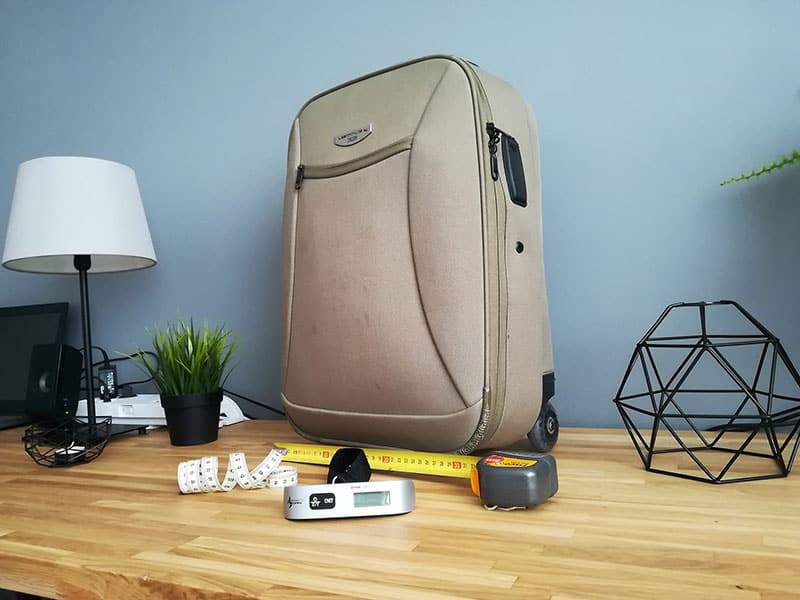
To measure checked luggage, use a tape measure and measure the bag at its widest outside points:- Height: from the floor to the top of the suitcase, including wheels and the top handle.
- Width: from side to side, including side handles if they stick out.
- Depth: from front to back, including expansion zippers, pockets, and bulging fabric.

Linear inches = height + width + depth
Example: 30 + 19 + 12 = 61 linear inches.
If you want a step-by-step visual walkthrough, see our guide on how to measure luggage for airlines.Do Airlines Use Linear Inches or Height and Width?
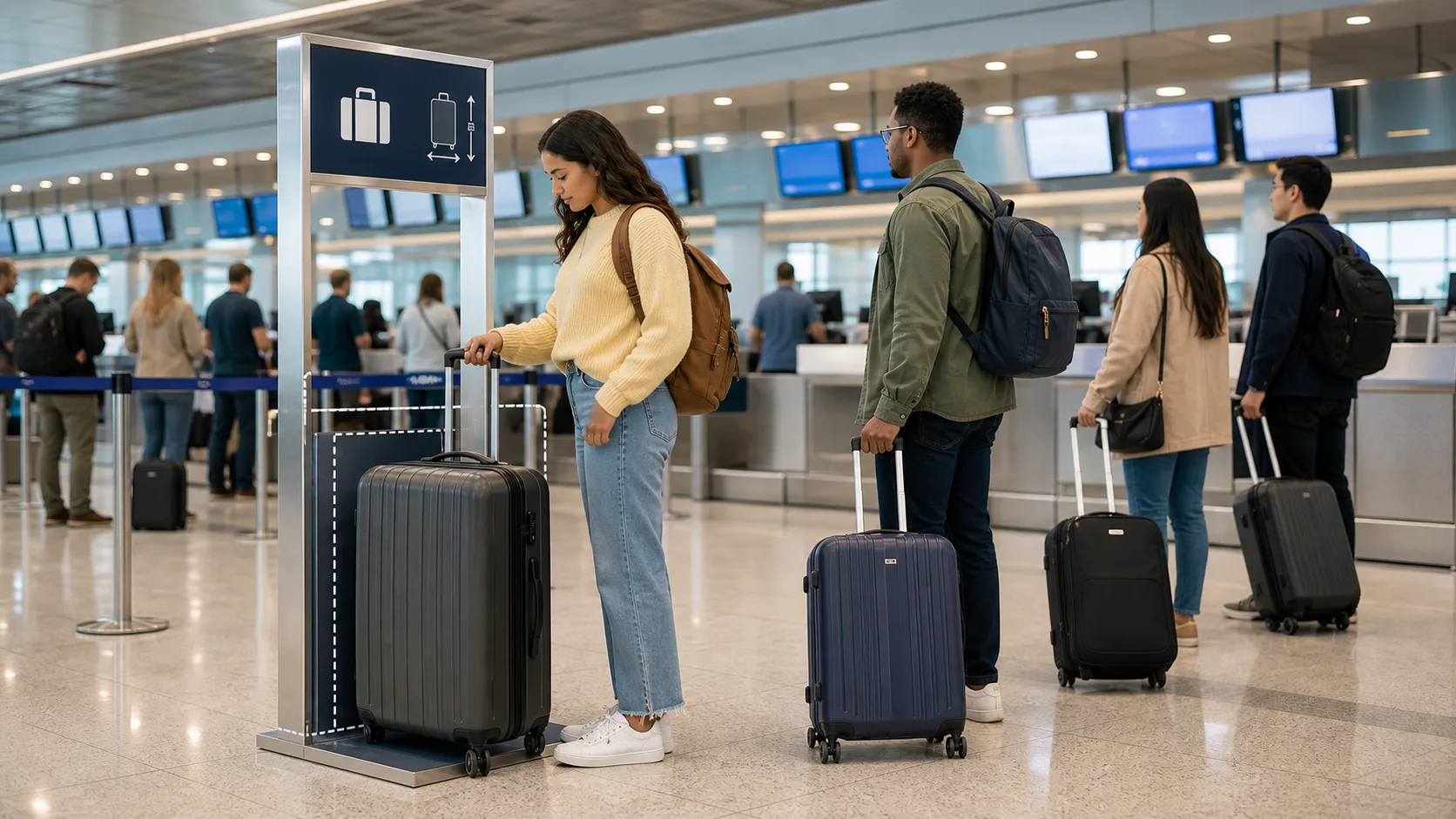
Airlines usually use different measurement methods for checked bags and carry-ons. Airports may provide scales, bag sizers, and check-in equipment, but the airline operating your flight sets the baggage rule.For checked baggage, airlines commonly use linear inches or linear centimeters. That means they add length + width + height together. A bag can be tall and still allowed if it is narrow and shallow enough, or it can be shorter and still oversized if it is very wide or deep.For carry-on luggage, airlines usually use fixed dimensions. Instead of saying 45 linear inches, they usually list a maximum such as 22 x 14 x 9 inches. Gate agents may use a physical bag sizer, especially on full flights, smaller aircraft, or budget airlines.| Bag type | How it is usually measured | Who decides the rule? | What happens if it is too large? |
|---|---|---|---|
| Checked bag | Linear inches or centimeters: length + width + height. | The airline operating your flight. | Oversize fee, overweight fee, special handling, or refusal if it is far beyond the limit. |
| Carry-on bag | Specific maximum dimensions, often checked in a sizer bin. | The airline operating your flight. | Gate check, counter check, or extra fee depending on the airline and fare. |
| Personal item | Usually must fit under the seat; some airlines publish exact dimensions. | The airline operating your flight. | You may need to move items into another bag, pay for a carry-on, or check the item. |
Common Checked Suitcase Sizes: 24 to 32 Inches
| Advertised suitcase height | Usually within 62 linear inches? | What to check before buying |
|---|---|---|
| 24 inch | Usually yes | Most 24-inch checked suitcases are comfortably under the limit. |
| 25 inch | Usually yes | A good size if you want checked luggage without pushing the limit. |
| 26 inch | Usually yes | Often a safe maximum for travelers who do not want to calculate every dimension. |
| 27 inch | Usually, but check | Many fit, but deep expanders and thick wheels can push the total higher. |
| 28 inch | Sometimes | Measure carefully. Some 28-inch bags are under 62 linear inches; others are not. |
| 29 inch | Sometimes, but risky | Look for a slim profile and official outside dimensions with wheels included. |
| 30 inch | Often oversized | Many are over 62 linear inches unless they are narrow and shallow. |
| 31 or 32 inch | Usually oversized | These are often better for road trips, cruises, storage, or airlines that accept oversize bags for a fee. |

Large Checked Bags: 28, 29, 30, and 32 Inches
Large checked luggage is where the 62-inch rule matters most. Once a suitcase gets into the 28 to 32-inch range, the advertised height alone is not enough to know whether the bag will be accepted as standard checked baggage.A 28-inch suitcase can be a good large checked bag if it is not too deep. A 29-inch suitcase can also work, but it is closer to the edge. A 30-inch suitcase is often oversized, and a 32-inch suitcase is usually too large for standard airline checked baggage unless the airline accepts it as oversize.29 vs 32 Inch Checked Luggage: Which One Is Better?
If you are choosing between 29 and 32 inch luggage, the 29-inch suitcase is usually the better choice for flying. It is still large, but some models can stay within 62 linear inches if the width and depth are controlled.A 32-inch suitcase is much harder to recommend for normal checked baggage. It may be fine for a move, a long road trip, a cruise, or a route where you are willing to pay oversize fees, but it is often too large for standard airline checked baggage size rules.There is another practical issue: weight. A 32-inch suitcase is easy to overpack. Even if the airline accepts the size, you may hit the 50 lb weight limit before the bag is full.If you want luggage that is designed specifically around the 62-inch rule, see our guide to the best 62-inch checked suitcases.If you are comparing actual models, start with checked suitcase reviews that list full outside dimensions, not only the advertised size. Good examples include our Travelpro Crew VersaPack 29-Inch review, Travelpro Platinum Elite 25-Inch review, Delsey Helium Aero 25-Inch review, and Samsonite Centric 24-Inch review.Checked Baggage Weight Is a Separate Limit
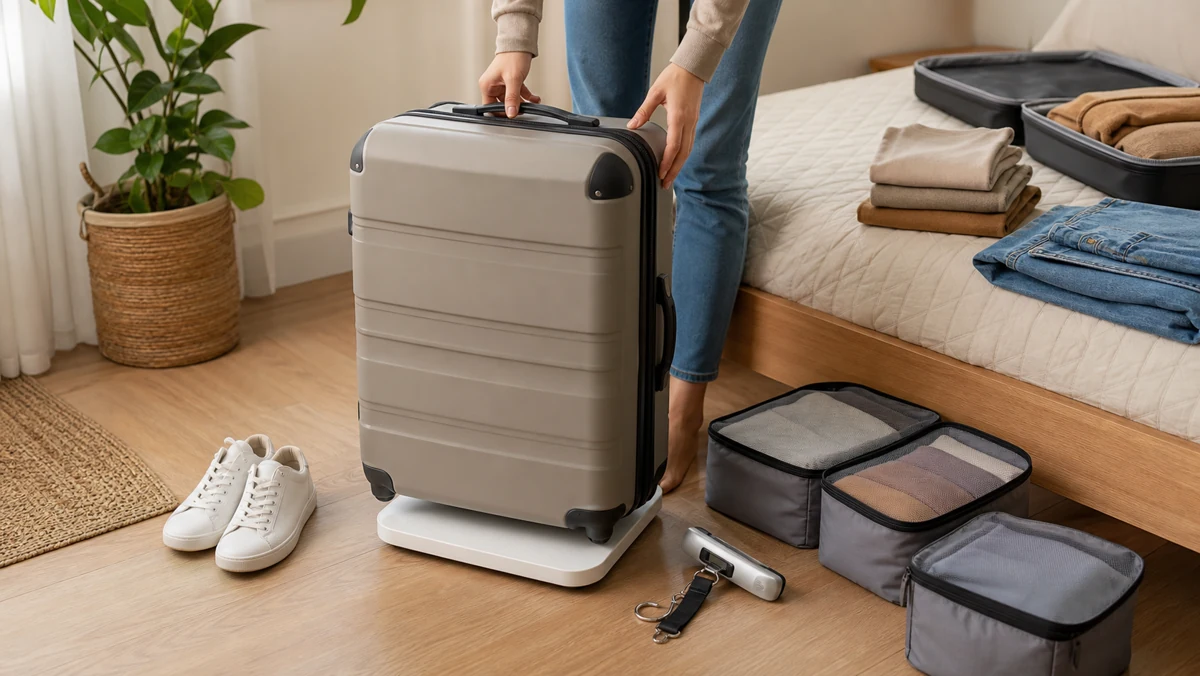
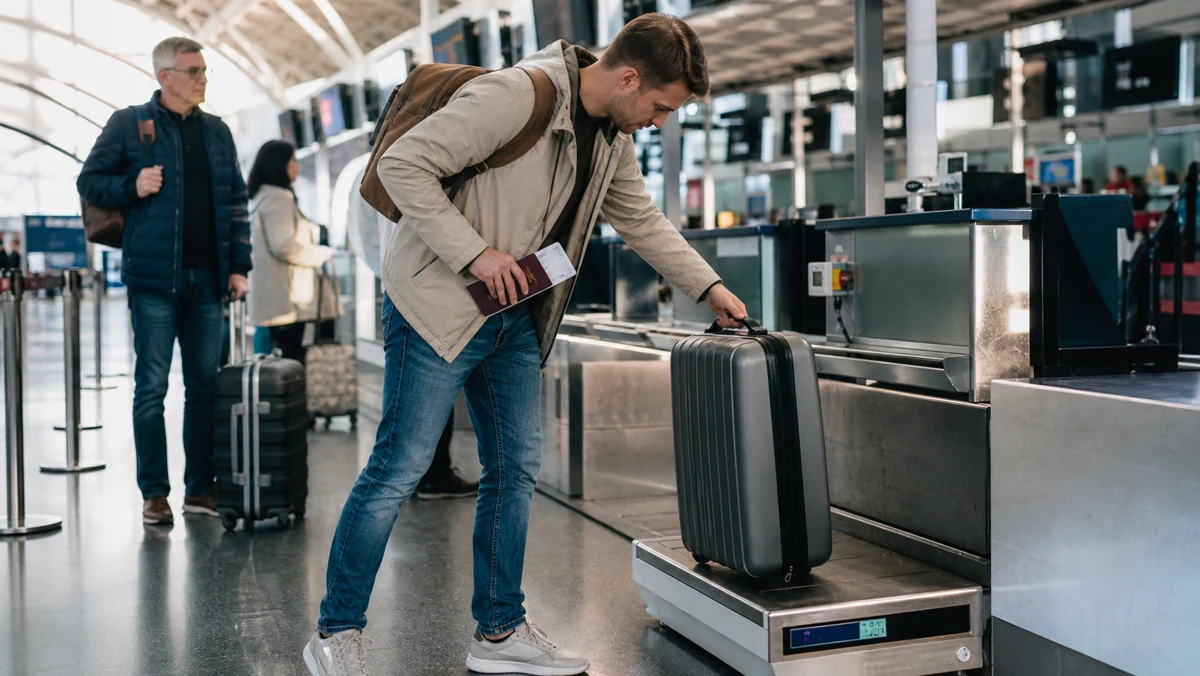
Checked baggage size and checked baggage weight are separate rules. A suitcase can be the right size and still be overweight.For many economy tickets, the common checked bag weight limit is 50 lbs / 23 kg. Some premium cabins, elite benefits, international routes, or military allowances may allow 70 lbs / 32 kg, but you should check your exact airline and ticket.The bigger the suitcase, the easier it is to pack past the limit. This is why a 29 or 32-inch bag can become expensive even when the dimensions look close. For a practical baseline, see our guide to how much an empty suitcase weighs and our guide on how to weigh luggage before a flight.
Is Checked Baggage Size Different for International Flights?
The 62 linear inch rule is common on international flights too, but baggage allowances vary much more by airline, route, cabin, fare type, and destination. Some international itineraries use piece-based allowances, while others use weight-based systems.Do not assume your domestic baggage allowance applies internationally. Partner airlines and connecting flights can also change which baggage policy applies.If your trip crosses borders, read our guide on how many bags are allowed on international flights before you buy or pack a large checked suitcase.Official Airline Baggage Rule Links
Use the links below to check your exact airline before you fly. These pages are better than relying on a generic chart because baggage rules can change by route, fare type, cabin, loyalty status, partner airline, and aircraft.| Airline | Checked baggage rules | Carry-on rules |
|---|---|---|
| American Airlines | Checked bag policy | Carry-on bags |
| Delta Air Lines | Checked, excess, and overweight bags | Carry-on baggage |
| United Airlines | Checked bags | Carry-on bags |
| Southwest Airlines | Checked bag policy | Carry-on and personal item policy |
| JetBlue | Checked bags | Carry-on bags |
| Alaska Airlines | Checked bags | Carry-on luggage |
| Frontier Airlines | Bag options | Bag size and weight limits |
| Allegiant Air | Baggage policy | Carry-on and personal items |
| Hawaiian Airlines | Checked bags | Carry-on bags |
| Air Canada | Baggage information | Carry-on baggage |
| British Airways | Baggage essentials | Hand baggage allowances |
| Lufthansa | Baggage overview | Carry-on baggage |
| Air France | Baggage information | Cabin and checked baggage |
| KLM | Baggage information | Hand baggage allowance |
| Emirates | Baggage information | Cabin baggage rules |
| Qatar Airways | Baggage allowance | Baggage allowance details |
7 Rules for Buying Checked Luggage That Is Not Oversized
1. Check the outside dimensions, not just the advertised height
The product title may say 28 inches, but the airline measures the full outside dimensions.2. Include wheels and handles
If wheels or handles add an inch, that inch counts toward the checked baggage size limit.3. Be careful with expansion zippers
An expanded suitcase can become deeper than the listed standard dimensions.4. Treat 29 inches as the upper edge
Some 29-inch bags are fine, but only if the total dimensions stay at or below 62 linear inches.5. Avoid 32-inch luggage for normal flights
A 32-inch suitcase is usually too large for standard checked baggage unless the airline accepts it as oversize or the bag is unusually slim.6. Leave room for weight
A larger suitcase encourages overpacking. If you regularly hit 50 lbs, a smaller checked bag may be cheaper and easier.7. Check your airline before every trip
Baggage rules can vary by route, fare, loyalty status, cabin, and season. The airline operating the flight is the final source of truth.FAQ
Is 29 inch luggage too big for checked baggage?
Not always. A 29-inch suitcase can be allowed if the total outside dimensions are 62 linear inches or less. Many 29-inch bags are close to the limit, so measure carefully.Is 32 inch luggage allowed on flights?
Sometimes, but it is often oversized for standard checked baggage. A 32-inch suitcase may be accepted with an oversize fee on some airlines, but it is not the safest choice for normal checked luggage.What does 62 linear inches mean?
It means length + width + height combined. For example, a bag that measures 30 x 20 x 12 inches is 62 linear inches.Do airlines actually measure checked baggage?
They may not measure every bag, but they can. If your suitcase looks unusually large, is overweight, or causes problems at the counter, the airline can apply oversize or overweight rules.What is the best checked luggage size?
For most travelers, 25 to 27 inches is the best checked luggage size. It provides useful capacity while keeping you away from the most common oversize problems.External references:- American Airlines checked bag policy
- Southwest checked baggage policy
- Delta excess and overweight baggage policy